
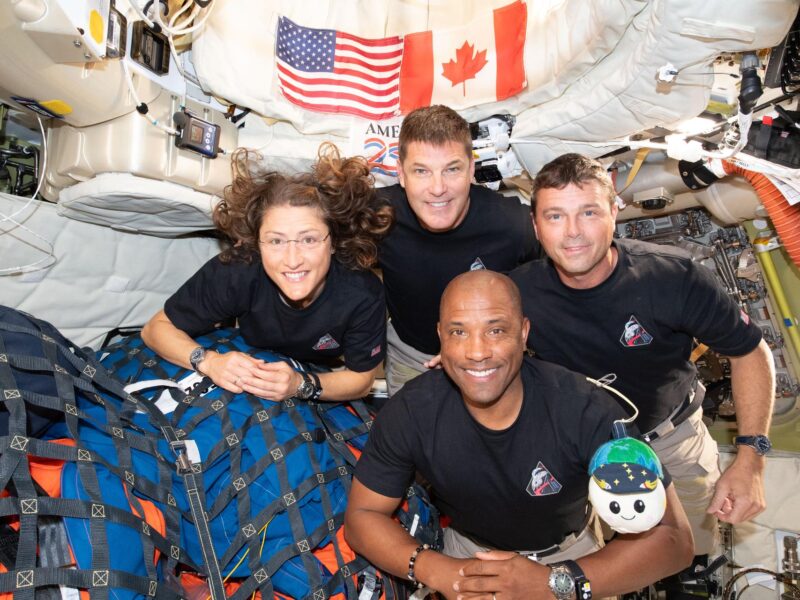
In case you missed it, the NASA-led Artemis II mission is making history this month as the farthest manned spacecraft to travel from Earth and around the Moon. Those of us on Earth are relying not only on the four astronauts’ extensive training, but also their eyes, to observe and share as much detail as possible about what they’re experiencing on this journey. With everyone’s eyes on space, The Vision Council Foundation wanted to dive deeper into everything vision-related when it comes to space exploration.
Your Eyes in Zero Gravity
While the astronauts on the Orion spacecraft might not have to worry about this on their 10-day journey, experts have observed that long-duration missions of six months or more can have potentially harmful effects on the eyes. Spaceflight Associated Neuro-Ocular Syndrome, or SANS, is a result of chronic weightlessness experienced in zero gravity. SANS is developed when bodily fluids move toward the head, and can lead to optic nerve swelling, folds in the retina, or flattening of the back of the eye. According to NASA, approximately 70 percent of astronauts aboard the International Space Station experience some swelling in the back of their eyes. While no lasting damage has been recorded, researchers continue to observe and address the impact space has on the eyes as humans continue to go deeper into space for longer periods of time.
It’s critical for astronauts to be able to see 20/20 during their missions, but vision correction in space can be a bit trickier to manage than here on Earth. The same shift of fluid that can cause SANS at zero gravity can cause changes to one’s visual acuity, meaning astronauts may see a change in their need for glasses or vision correction, or a change in their prescription once they are in space. It’s not uncommon for astronauts to bring their glasses that they use on Earth, along with some back up pairs at different strengths in case of any changes in visual acuity. Properly fitted glasses will work fine and stay put in microgravity, but astronauts can also use contact lenses, though contacts in space may have a greater chance of causing dry eye. Glasses or contacts, astronauts can feel assured that their vision correction tools will work just fine for their missions.
UV Protection
UV-protective eyewear is a big deal here on Earth, and we have space travel to thank for that. In the early days of space exploration, astronauts were subject to intense, unfiltered solar radiation, which we know today can cause cataracts and age-related macular degeneration. Inspired by protective oils in the eyes of eagles, NASA scientists in the 1980s created a new lens technology that was applied to astronauts’ eyewear. This research and technology was the foundation for Eagle Eyes Optics, an inductee of The Space Foundation Hall of Fame for their contributions to these developments. These UV-blocking and color-enhancing coatings have evolved and expanded into what we see and use in everyday sunglasses.
Axiom Space, the outfitter of the projected 2027 Artemis III mission, announced last year that they would be partnering with Oakley on the visor system for the Axiom Extravehicular Mobility Unit (AxEMU). Oakley, part of EssilorLuxottica’s portfolio, will contribute their expertise to creating a two-part, gold-coated visor that will take another crew of astronauts on a mission to land on the Moon next year. The visor technology will shield against radiation while delivering crisp colors and clarity the astronauts need, because while glasses have to reach certain technical standards here on Earth, eye coverings like visors are held to even stricter guidelines in space.
A Solar Eclipse Unlike Any Other
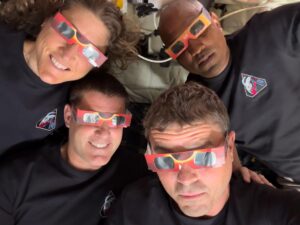
On their seven-hour journey around the dark side of the Moon, the astronauts witnessed one of the coolest scientific occurrences: a total solar eclipse. While the last total solar eclipse occurred here on Earth in April 2024, the Artemis II crew was able to experience one from their vantage point in space. The moon phase at the timing of the launch set the team up for success, as the far side of the Moon was mostly dark, allowing it to perfectly block out the Sun. Just like on Earth, astronauts had to wear eclipse glasses to properly view the solar corona before and after totality. As The Vision Council Foundation previously outlined, eclipse glasses must be ISO 12312-2 certified to properly filter harmful ultraviolet, infrared, and visible light that could cause permanent eye damage from looking directly at the sun.
Accessorize Like an Astronaut

You might not have room in your wardrobe for a full spacesuit, but don’t let that stop you from looking like an astronaut. Artemis II astronauts Christina Koch and Reid Wiseman were spotted wearing Art-Craft Optical’s latest AERO Aviation Technology sunglasses in the days leading up to launch. Keen-eyed opticians have also spotted Koch wearing Silhouette frames going about her day-to-day activities in space on the Orion, a brand that has a celebrated history in space. Another company that is no stranger to space is American Optical, whose Original Pilot frames were added to astronaut survival kits back in the 1960s, and eventually became the first sunglasses on the Moon.
While we await the astronauts return and eagerly look forward to more missions, it’s fun to learn how they protect their eyes from UV exposure and how scientists are exploring solutions to keep our vision safe in space.